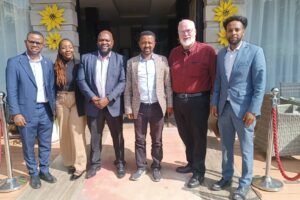
A national consultation meeting on urbanization and informal settlements was held at Taye Belay Hotel
Urbanization is an ever so relevant issue in inner city areas across the world. And on September 29th and 30th 2017 a national consultation meeting titled Our Cities, Our Future: Towards Inclusive Neighborhoods, which focused on just that was held. The consultation meeting, which was sponsored by Erasmus ( a program of the European union), could be described as a short of advising that will assist other countries, and maybe Ethiopia, to take the necessary steps to combat the issues that will arise in cities.
[widgetkit id=7033]
Dr. Asrat Atsedeweyn, academic vice president of UoG was there to open the event. His presence at the occasion came with some insight that allowed the guests to understand what the consultation meant to growing countries. “Over the course of the next two days,” he said, “significant issues on urbanization, urbanism and informal settlements will be discussed and shared amongst urban professionals, officials and practitioners. We will work towards creating better and inclusive communities for our citizens.”
The vice president alluded to the fact that cities in developing countries, including Ethiopia, are experiencing the inevitable phenomenon of urbanization. And that most cities have been expanding horizontally and the population is moving into unplanned settlements on the peripheries in the agricultural lands.
Most urban centers are becoming congested with a constant influx of migrants, which subsequently transforms those areas into slums. A constant failure to determine how to effectively deal with the multidimensional aspect of urbanization causes such results.
Professor Richard Sliuzas, Professor Uwe Altrock and Dr. Tania Berger were guests who were invited to share their experience that specifically dealt with the issues of informal settlements and slums.
Prof Richard, who is from the United Kingdom, spoke of the untold truths of slums and their inconvenience to society. “Slums are not put on the map because of their informality,” he said. But his underlying advice was the fact that it is a must to know where all such settlements are because the knowledge of their whereabouts will advance urbanization.
Therefore new technology, such as flying drones, has made it possible, in a cost efficient manner, to get a clear picture of the most densely affected areas. These high quality images, which are more suitable than satellite imagery is easily accessible and effortless.
Likewise, Ethiopian urban centers are characterized by massive housing problems as well and the consultation may even help our needs. Around 70% of Ethiopia’s residents currently live in substandard housing. Such fast-paced urbanization requires everyone’s combined effort.
The project that was announced on the 29th and 30th was jointly designed to bring the living conditions of informal settlers to the attention of policy makers, professionals and practitioners so that the appropriate measures are taken to alleviate any future mistakes in the sector.
The project has several components, amongst them; an action- research and awareness creation on the conditions of informal urban settlers is one of the most important. As one of the best public higher educational institution in the country, it cannot be overlooked, that the University of Gondar, which has 64 years of community service experience, will assist in this aspect.
Even though Ethiopia cannot be compared with the likes of Brazil and India when it comes to informal settlements and slums, this consultation meeting is a topic that all people should look into so that a direct path towards a more sustainable approach towards urbanization is realized.
By Samuel Malede| Public and International Relations Directorate