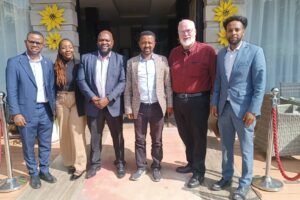
Professor Steven Youngblood presents Peace Journalism: its principals and practices
On 19 April 2018 the University of Gondar’s Journalism and Communications department organized a seminar and introduced one of their visiting professors, Steven Youngblood, who is working to educate up and coming journalists. Mr. Youngblood, who is a Professor at Park University, gave a well thought out presentation on the principles and practices of ‘Peace Journalism’.
Students and lecturers who attended the presentation listened attentively to the Director of Global Peace Journalism while he dissected the ways one could spot the differences between Traditional Journalism and Peace Journalism.
[widgetkit id=8959]
In underdeveloped nations it is all too familiar to see the freedom of expression being stifled. The freedom of press and speech are usually said to be at odds with the values of authoritarian regimes therefore these basic fundamental concepts are often times overlooked and suppressed.
According to the professor from Park University, Peace Journalism differs in many ways from its counterpart. Traditional Journalism often times illustrates violence and war which focuses on propaganda, negativity and conceals peace initiatives ‘before victory is declared’.
The language also is different when one writes in the traditional journalism form. “Demonizing, victimizing and sensational language is often times used to put fire on the flames of problematic issues and makes bad situations even worse” said Professor Youngblood.
The objectives of Peace journalism is quite different though. As its name implies, it more often than not seeks to reconcile and end conflict with well thought out algorithms which stray away from dehumanizing reports.
“By focusing on educating, confidence building and promoting cross-boundary participation in reconciliation processes peace journalism is crucial and vital to countries” stressed Mr. Youngblood.
Peace Journalism may be a new concept in the Horn of Africa but it could have a sizable impact in the lives of many. In addition, for a country like Ethiopia, which is 137th in the World Press Freedom Index, such concepts may create an environment where all people are portrayed in a truthful and unbiased manner.
By Samuel Malede| Public & International Relations Directorate