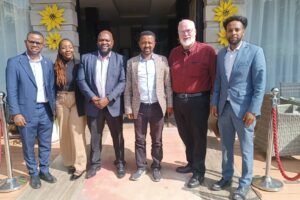
The Social Science and Humanities College at UoG organized a seminar on Urbanization and its Linkage with Rural Economies
On 1 February 2018 Professor Tegegne Gebre- Egziabher from Addis Ababa University, and who teaches Geography to PhD students at the University of Gondar, spoke in length to a crowded Markai campus auditorium about urbanization and its linkages with rural economies in Ethiopia. Focusing on the individuals’ migration from rural places to urban ones, Dr. Tegegne in his public lecture reflected on the positive and negative effects of Urbanization.
According to a Stockholm study a population that is urban is one in which vast numbers of people are clustered together in very small areas called towns and cities. Urbanization is a process of population concentration. It proceeds in two ways: the multiplication of points of concentration and the increase in size of points of concentration.
[widgetkit id=8223]
Professor Tegegne managed to reassure that though Ethiopia’s urban standing in Africa is relatively low there are still other exceptional indicators of positive growth. The present level of urbanization is 19% in Ethiopia, 51 % in Ghana and 40 % on average in Africa.
According to the Professor even if the level of urbanization in Ethiopia is low by African standard, the rates of urbanization in Ethiopia are exceptional. Until 1985 the growth rate was more or less the same as the whole of Africa. But in the last two decades the growth rate was very fast in Ethiopia, while the rate largely declined in other African countries.
For the first time in a while according to Prof. Tegegne the urban population is now more than the rural population. In 2014 it was at 54 percent of the population and it is projected to reach 66 percent by the year 2050.
It may seem as if the rise of city centers and the decline of rural areas would be a beneficial thing for a country but from the looks of it urbanization may have some drawbacks. Some of the effects of urbanization are high population density, inadequate infrastructure, lack of affordable housing, flooding, pollution, slum creation, crime, congestion and poverty.
But from the words of Prof. Tegegne structural transformation and industrialization cannot happen without constant urbanization. For a country like Ethiopia these two concepts are pillars of its future growth. And maybe in the upcoming years other cities in Ethiopia will contribute to its urban scene. Cities like Gondar, Bahar Dar and Dessie just might add an additional boost to progress urbanization that will ultimately lead to much needed industrialization.
By Samuel Malede| Public and International Relations Directorate