UoG organizes a Seminar on Ethio-Sudan Relations
Boundaries are not only the regional boundaries of a sovereign state, but also the means by which the people of a country are included in their citizenship and move freely. It is well known that the borders of a country are the international lines through which a government can lead and govern its people responsibly. However, despite the fact that Ethiopia and Sudan share a border of more than 1,600 km, it has not been recognized for a long time.

To fill this gap, the University of Gondar has been conducting various national discussions based on research. It is to be recalled that the University of Gondar sponsored and published a historical book entitled “The Historical Process of the Ethio-Sudan Boundary and Solutions to the Problems” which was written by UoG’s senior Professor by Prof. Mulatu Wubneh.
Hence picking up where the University left off, a workshop was held today, February 16, 2021 to strengthen the historic and brotherly tie between the two countries and shared on how to resolve Ethio-Sudan differences peacefully.

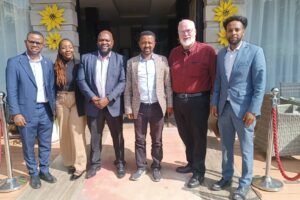
The President of the University of Gondar, Dr. Asrat Atsedeweyn, Dr Omer Al Amin, Dean of Art College, Khartoum University, senior members of UoG, lecturers of the College of Social and Humanities, and invited guests attended the discussion.
In his welcoming address Dr. Asrat spoke soberly about the relations of the two countries and how brotherly countries should resolve their tensions. He expressed, “Unfortunately, while the two countries are deeply intertwined in culture, history, religion, languages and the likes there has been ongoing disputes between Ethiopia and Sudan that deserve an immediate halt and sustained normalcy.” When sharing his insight Dr. Asrat brought up Europeans and their hostile history. “The Germans, the French and the English all had hostility towards one another in the past. Even though these countries were rivals and fought one another because of national interest it is clear presently that they are working together in unity and solidarity. As a result, we are seeing how much they have benefited.”

The only thing that needs to exist between Ethiopians and the Sudanese is such a cooperative relationship. The Ethio-Sudan border should not be a place where both countries fight and kill, but a development corridor where the two peoples can prosper together. And Dr. Asrat shared that it is, not only with the federal government, but equally as important the Educational Institutions that change will come.
Likewise in his keynote remarks Dr Omer Al Amin, Dean of Art College, Khartoum University shared with the audience members that there is no difference between the people of Sudan and the people of Ethiopia. He created a metaphor drawing similarities between animals and that even the different species of Sudan and Ethiopia are identical and one cannot tell them apart. When asked about the boarder conflict he was straightforward and clear in his response. “You can say that there are outside influences that try to destabilize the region, but we Sudanese are smarter than that,” he shared.
He expressed with optimism his wish to see a peaceful region where things are back to normal, but the Professor from Sudan called on all parties in the government and the Intellectual community to do their part to bring things back to normalcy.
The University of Gondar is working in partnership with 7 Sudan based universities, which include University of Khartoum, Sudan University of Science & Technology, University of Kassala, University of Gedarif, Blue Nile University, and Sennar University in the hopes to strengthen ties and to create a better future for both countries.
Hence, it may be time to rethink the roles of educational institutions in solving some of today’s most pressing issues which include the Ethio-Sudan Boarder and the Grand Ethiopian Renaissance Dam. The sisterly Universitys’ footprint in the sustained development of the two countries is needed now more than ever and UoG is prepared to do its part to further the aims for a more prosperous region.